Thursday, June 16, 2011

Day 16 - The Other Daibutsu

Nara was the first official capital of Japan, and the first place where Buddhism came to this country. It is now also famous of its deer park that surrounds the plethora of Buddhist temples. Among these temples is Todaiji, arguably the most famous temple in Japan.

The first thing I noticed was the deer. They populate a vast expanse in Eastern Nara that is home to Todaiji, The Nara Museum, and a number of shrines and temples. These deer are mostly tame, although there are signs to remind you that they are wild animals and sometimes attack people. That was a comforting thought.

At any rate the Daibutsu this time was under a building. Not only is the statue larger than the one in Kamakura, the building is the largest wooden structure in the world. That was something worth seeing. I headed on inside and even bought a buddhist charm. It was more a souvenir than any belief it would work, but I got the charm for gaining new skills easily.
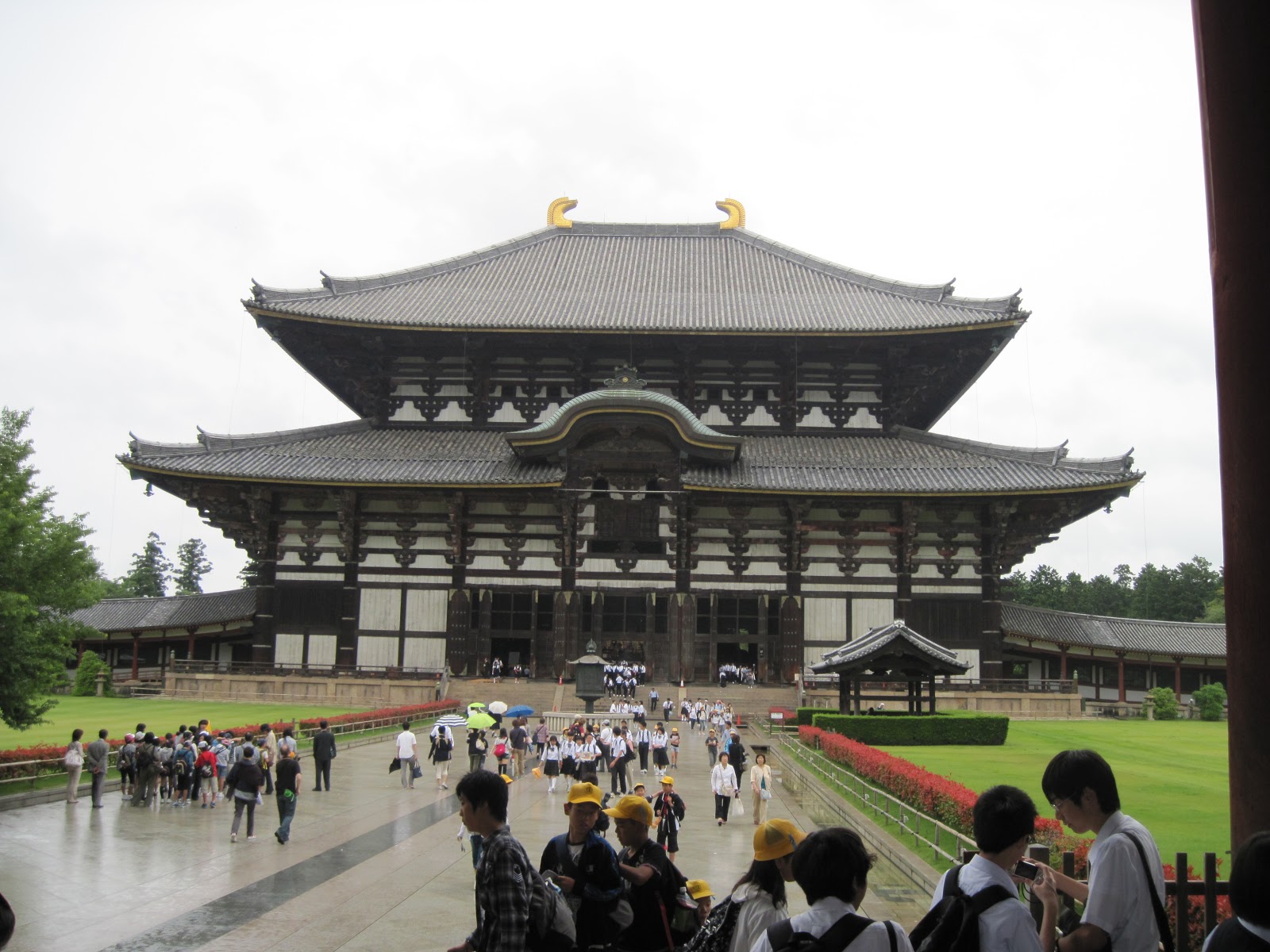

Todaiji, the main temple in Nara, was once the head Buddhist temple in all of Japan, and actually grew so politically influential that the emperor moved the capital away from Nara just to be out of their influence. 

When I was done looking at the giant statue of Buddha (you'll have to look at my gallery for that one. If you missed it the link is up there under the picture), I went up the hill to another temple that had a great view out over all of Nara and the temple complex. I didn't even realize I was on a mountain until I looked out and saw how much higher than the rest of the city I was. It was at this point that it really started to rain. 

The rain picking up and turning into a downpour, I decided maybe it wasn't so good to keep walking around the temple complex. I was stopped, repeatedly, on my way out by more elementary school children asking me my name and things about me. At least this time they were grateful enough to give me a sticker and a pamphlet for the area they were from (It was the Gifu region, if anyone was wondering). This will make the 9th time I have been interviewed by small Japanese children. At first it was entertaining, and on some level it still is, but I really didn't want to stand out in the rain to talk to them.

But I am too nice of a person to say no to small children asking in broken English if they can talk to me. 

Around the temples there are a bunch of small stores with souvenir nick-knacks, and on the route from the station I found a Japanese antique store. I am declaring it the coolest store ever. If you think old things are cool, and Japanese things are cool, then it is awesome to walk into a store with Samurai helmets (both full size and decorative), Masks of all kinds (used in Japanese theater), swords, and ceramics. I spent a while just walking around trying not to touch anything. The whole 'you break it you buy it' thing is only okay if the items in question aren't upwards of 500 dollars. By the way I found a $500 carved elephant tusk in there. That was kind of cool.

The deer in the area mostly ignore you, passively eating grass or walking around. Until you buy the deer crackers. They sell little packets of deer crackers all over the park, and the second one of them smells the crackers, they're all over you. Someone volunteered to take pictures of me trying not to get eaten.

They can be aggressive.
The things are so interested in food that as soon as they see you with the crackers they come over to you. And they aren't shy. So if you hold the crackers too low they will take them right out of your hands. Two fun stories from my deer-feeding experience (besides the story about the picture above). If you feed one deer and another sees you, it might just start looking for food. More than once I felt a tug on my pocket as a deer started nibbling on my pants. One even went into my pocket and tried to eat my map. Also interesting to note, they seem to have associated plastic bags with food. Because I had a grocery bag tied to my backpack, and one of the deer decided to play tug of war with it because he thought more crackers were inside. I was literally playing tug of war with a deer over a plastic bag.

If you ever want a hands-on deer experience, go to Nara. Just be careful where you keep your food.

Cory

Wednesday, June 15, 2011

Day 15 - Boy, you sure have gotten bigger!

Kamakura, a small city to the south of Tokyo, was once the capital of Japan. But you wouldn't be able to tell from looking at the place. In fact, I would say that it is the smallest city I've been to so far. I pretty much walked the length of it in an hour.

Nevertheless, it still has its claims to fame: an overload of shrines and temples, touristy shops, and arguably its most famous attraction, the Daibutsu (literally, "Great Buddha"). The Daibutsu is a bronze statue of Amida Buddha, a Buddha worshiped heavily in Japan. It stands somewhere on the order of  13 meters, which would be somewhere around 40 feet but I hate the metric system so I don't know the exact conversion. Sue me, I'm American.

Instead of me telling you how big it is, I'll just show you a picture.
I'm going to go with, "really really big"

It is noteworthy that the Kamakura Daibutsu is only the second most famous in Japan. The first being the Daibutsu in Nara. This colossal meditating statue used to be covered in a wooden pavilion in the typical Buddhist style, but hundreds of years ago, after rebuilding it again and again after earthquakes, fire, and tsunami, I imagine the priests agreed that maybe it was meant to sit outside. So it does. I think it gives it a great look set against the trees under the open sky, though.

The statue is also hollow, and you can go inside of it. Inside is a plaque describing how it was built and later reinforced. Since it is so large, it was cast in 30 stages, and the stages were sort of welded together using three types of joints which are all visible on the inside of the statue. After the Daibutsu was named a National Treasure, a steel girder was placed inside to reinforce the structure in case of an earthquake. It is green, like the Statue of Liberty, because of oxidation.

The actual city of Kamakura is a shopping city with traditional and tourist wares alike. The same tourist  t-shirts available everywhere are found here, but so are traditional 'Kamakura carvings'. I personally chose to stop in and try the local flavor of soft serve ice cream: Sweet Potato. 

I know it sounds gross. But in Japan sweet potatoes are seen as a dessert item, rather than the way we treat yams, as a side dish at turkey dinners. So, it makes perfect sense for them to make it an ice cream flavor. After all, they also have green tea flavored ice cream, and that isn't a dessert item. 

The sweet potato ice cream was surprisingly good.

On my walk back to the train station (Kamakura is about four hours from Osaka by train) I also went to the Hachiman Shrine in Kamakura. Hachiman worship is an interesting phenomenon in Japan. Initially, Hachiman was neither "Shinto" or Buddhist. It was its own form of worship which, if I remember correctly, came from outside the country. Could be wrong though, it might have developed domestically. 

Hachiman is the god of War, or more precisely, of warriors. He is often depicted with a bow and arrow, and he has become both a Shinto kami (god), and a bodhisattva (enlightened servant of the Buddha). So, he is worshiped under the auspices of both Shinto and Buddhist worship, which makes him something of an oddity.  At any rate, his shrine in Kamakura is architecturally magnificent.

I made it bigger so you could see more closely.


And I'll talk to you tomorrow.

Cory

Tuesday, June 14, 2011

Day 14 - Festival


In historical Japan, rice was life. Lords paid their samurai in rice, Farmers were the second-highest social class, and the rice seedling was sacred. From this relationship with rice, various rituals developed to pray for the fertility and supply of rice crops. At Sumiyoshi Taisha, a shrine in southern Osaka, these rituals are preserved in the Otaue Festival, held on June 14th. I was lucky enough to be in town for this one, and it was certainly an event.

The entire festival takes place at the shrine, which contains a large circular rice paddy with a raised stage in the center. This is the primary locale of most of the ceremony. First, they till the paddy with an ox-drawn paddy plow. Today most farming is mechanized, but for the ceremony they use a traditional ox.

The ox figured out towards the end that the people were taking turns.

At the same time as this tilling is going on (can I call it tilling?), at the main shrine they hold a mock-imperial court complete with all sorts of period costumes. Samurai, courtly ladies, farmers, and children dressed as all sorts of things (from foot soldiers to noblewomen) took turns going before the "Emperor". When they were finished, there was a grand procession across the grounds of the shrine to the rice paddy. This was a parade of sorts, and this was where I got my best pictures.


The procession moved to the rice paddy, surrounded it, and then new ceremonies began. The farmers took their places in the paddy and began to plant rice seedlings across the entire width of it. This alone took almost 2 hours with the 20 or so farmers they had there. In the meantime, various groups from the procession took turns with rituals around the pit or on the pedestal in the center. The noble ladies danced around to a traditional Japanese song, the Head samurai sat on a stool and watched footsoldiers (the children) have mock-battles around the outside to the beat of his drum. Two women sang whilst girls dressed in medieval Japanese formal wear did a fertility dance around the ring. Various priests did prayers and rituals. And an old man went to the center and opened a giant umbrella, rhythmically striking the pole it was mounted on to give a beat while a different set of girls danced and slapped fans together that had bells attached to them. Meanwhile, the farmers kept planting the entire time, eventually filling the area of the pit, at which point the ceremony was over.

It was very cool to see all the kinds of traditional attire, much more fleshed out than the simple samurai/kimono wear that you see most of the time at 'traditional' events. You can see more examples in my gallery.

The shrine itself was also beautiful. It can be differentiated from the temples I've visited by the roofs, which are thatched rather than tiled, and they have the x-shaped brackets on top. Also, you will see ropes with white zig-zaggy tags around some objects. This denotes the objects as sacred. Trees and Rocks are commonly sanctified with these ropes.

On my way back, I stopped in the Minami district, or southern part of Osaka, known for its shopping. It mostly streets of shops filled with crowds of young Japanese. I personally didn't see that much difference between the South side of Osaka and the North area I toured before. However, there were more "red-light" areas in the southern half of Osaka. I also went into a pet store in the Minami district. Here, "Toy" dogs are the most common, and so the pet stores usually have fish-tank sized enclosures with really small puppies and kittens in them. They are always very cute, but I wonder where you could buy a larger dog in Japan.

Did I mention I biked all this way? Yeah, it was about twice as far as my trip to the aquarium, which was about 10 miles round trip. I definitely prefer biking to walking though, and the trains to the shrine were inconvenient. Biking also gave me the opportunity to see more of the city than if I just took a train.

After checking out the shopping area, I dropped into a noodle shop for some 200 yen (about $2.50) udon, which is a type of Japanese noodles. They're very thick (made of buckwheat) and served any number of ways. I just like them in a soup, but I threw in some crumbles made from fried batter to make it saltier. Also some soy sauce. Then I went down the street and bought an ice cream bar that is the best spin on an ice cream sandwich ever. First, its completely sealed so no worry about a mess. Inside was green tea flavored ice cream (one of my favorites), azuki (red bean jelly), and some white sauce stuff from hokkaido. I can't read the label so I don't know what it's made of, but it tastes like bananas.


I feel kind of very touristy taking pictures of my food, but I need to share this with somebody.

Cory

Monday, June 13, 2011

Day 13 - The Most often Mispronounced Japanese City

I chose a poor day to go to Hiroshima. It turns out that the Peace museum is quite a bit the school field trip you would think it is. Remember how I was interviewed in English by the boy at Kinkakuji? Well, today I was interviewed by more elementary school students. Five times. It was kind of creepy actually.

See, they were roving all over the park in herds looking for foreigners to interview for their English class, and well, I was the only foreigner, and I'm kind of easy to spot. I would hear running footsteps and sure enough swarms of elementary school children were sprinting towards me with "Hello!" pronounced in a Japanese accent. I would only make it thirty yards or so before another crowd would run up to me. For the record, My name is Cory, I come from America, and I like Football, Strawberries, and Udon. Those were the answers to the questions they asked me.

The museum (once I got to it) was an experience. It's the kind of thing that's even harder to describe in Japanese, because the Japanese word for 'interesting' (omoshiroi) also means 'fun'. And its never 'fun' to go to this kind of museum. They have in the park the remains of the only building left from the bombing. They call it the A-bomb Dome.


The museum itself was first a history of the buildup of WWII escalation in Japan and a historical outline of the events of the bomb, and then a collection of models and artifacts from the day the bomb was dropped. It went into great detail about how the bomb worked, so for example now I know the difference between a hydrogen bomb and an atomic bomb. 

The scale models were highly detailed, showing the before and after of the area around the museum, which is situated near the Hypocenter (the area directly below where the bomb was detonated mid-air). It also featured firsthand accounts of the day's events and a description about the lead up to the bombing. 

Something I didn't know: the elementary school children from a number of schools (about 6000 children) were evacuated out of the city in anticipation of conventional bombing raids and left their parents behind. This was a blessing and a curse. Yes, they survived, but they all became orphans.

It also clarified the narrative we learn in high school. It's never exactly what we learn in school, is it? But it was not as different as I imagined. First, the justification for using the atomic bomb on Japan. What we hear in school: we had to do it or we would be fighting a ground war in Japan from door to door and we would lose hundreds of thousands of soldiers. What I heard at Cornell: In fact, it was a show of force to decrease Soviet ambition in the postwar period through intimidation.

What I learned was that they are both partly true. Since the start of the Pacific War, the government here attempted to indoctrinate its residents that an honorable death was preferable to surrender. A PR campaign asked for 100,000 honorable deaths from the Japanese. It was working quite well, actually, as the US learned taking Okinawa. That was a very costly affair and it was only a small island of Japanese. So, had they attempted to take the mainland, it would have been very bloody.

But I also read letters today about strategy leading up to the bomb. Initially it was thought to be used against Germany, but since it was German technology that inspired it (it came from Einstein and his colleagues) they assumed that the Germans would learn too much if it was used on them. After it was decided to drop it on Japan (before we learned the ferocity of the Japanese at Okinawa), 17 cities were chosen and Nagasaki and Hiroshima were chosen because their topography would magnify the effects. So it was to be a show of force as well. This was also explicitly written in the letters that I read: that it would be effective in limiting the Soviet control of the region. 

I also learned that every nuclear test worldwide is sent a personal letter from Hiroshima's mayor asking them to stop and protesting the further development of nuclear weapons. The wish of the people of Hiroshima is a world without nuclear weapons. It makes sense, seeing as we could destroy the world many times over with the amount of power we have created. But at the same time I see why this can never be done. Because even if the US and Russia and all the nations of the world decommissioned every one of their nukes, there would always be lunatics like the Iranian president who want to wipe a place on Earth off the map. The only thing stopping these lunatics is fear of reprisal from a much larger force, and thats why as long as lunatics can have their own regimes, we can not completely eliminate our nuclear arsenal. Still, the vision that Hiroshima has for the future is a good one, if it could only be.


Cory

Sunday, June 12, 2011

Day 12 - The Great Cake-scapade

I'm going to talk about today in reverse. That's because the last thing I did didn't have anything to do with Japan and so I want to get it out of the way. I think I mentioned yesterday how I was going to buy a cake to celebrate my friends' wedding. Well, I had to settle for cheesecake. I thought it would be best to get a real cake, being a wedding and all, and I really did try very hard, but to no avail.

I searched two supermarkets, three specialty bakeries, and a department store, and I could not find an honest-to-God cake. From this I can surmise one of two things: either there is a terrible cake shortage in Japan, or the Japanese just aren't that into cake.

"Not into cake?", you say. "How can anyone hate cake?"

Well, actually, I do. That's kind of why I'm not upset that I had to settle for its cheesier cousin. Nevertheless, it shows a cultural difference in how they view desserts. Cheesecakes were everywhere, as were these roll things where cake-like bread is rolled with some derivative of whipped cream and various sweets. Also you have your custards and your jellies, and I've already gone into the amazing pastries here. The common denominator I have noticed is fruit. And cake has no fruit. That must be why. Actually I have no idea why, this is just speculation.

Nevertheless, I got a cheesecake with berries baked into it to celebrate their wedding here in Japan.

mmm...cheesecake.

The other thing I did, the thing I did first, was visit the Fushimi-Inari Shrine in Kyoto, which scales a mountain. A common feature of Shinto Shrines is the Torii gate, as you have seen in my pictures before. Well, This particular shrine is known for its Torii gates.

lots and lots of torii gates.


The trails are literally lined with torii gates. It was a fair hike up to the fourth station, which has a small restaurant and ice cream shop, and that is as far as most people go. To which I say: I didn't come to Japan to do things half way. So I hiked for another hour and a half to get around the steep looping trail that went up to the topmost shrine on the mountain and back down again. At shrines all over the mountain, people would pray and ring the bell in the shrine and pay an offering. I was particularly amazed by the volume of the gates, as you can see from the picture above, there were hundreds. The numbers thinned somewhat as you go farther up the hill, but you can still see the stone bases that they were once planted on, indicating that age has taken a number of the gates from the hillside.

Also, there were statues of foxes all over the mountain, the symbol of the shrine. In the foxes' mouths they often are seen carrying small objects, sometimes keys. The keys, I have heard, are supposed to be for the grain shed. It is important to note that the numerous torii gates (the link is in the last paragraph if you missed it) are all donated. For a few thousand dollars you too can have your name carved on the back of a torii gate at the Fushimi-Inari-Taisha. This is probably because this shrine is celebrated as a place to pray at for greater wealth. 

I wish I had greater wealth.

Cory

Saturday, June 11, 2011

Day 11 - I can only attribute it to magic

I ran into Matt and Sonya again today. This is the Matt and Sonya I met at Kinkakuji in Kyoto, remember? Well, I met them this time at Ueno station in Tokyo. Almost 300 miles away.

Let me explain how impossible it was. They were just passing through the station on their way to Starbucks, and I was passing through in a different direction to get pastries from a bakery. Even without that, realize that there are about 12 million people in Tokyo, and I happen to bump into the only two I have ever met before. Not only that, but I met them because the rain delayed my bullet train for 20 minutes. There is no way to plan this. I can't even begin to explain it.

I went to Tokyo today to visit the National Museum in Ueno Park. I also hopped over to Harajuku to stop by the Meiji Jingu--the place where Emperor Meiji is deified.

The first thing I passed in Ueno park was a statue of Saigo Takamori. He is known as the last real samurai, and the movie The Last Samurai is based on his final rebellion and death.

also he has a dog

The National Museum was incredible. They have a massive collection of Japanese and other Asian Artwork and artifacts. In fact, they can only display a portion of it at any one time, so the exhibitions always are changing. I was lucky enough to visit when they had a sword forged by the sword maker Masamune, one of the most famous in Japanese history.

They also had areas of Japanese pottery from all ages, and ancient archaeological finds. There was an entire building with artifacts found in the archives of a Buddhist temple. Many of the items are what Japan designates as Important Cultural Properties, or even National Treasures. I even saw a real Ming Vase. It was a good chance to see not only what Japan's history has left behind, but also to see what Japan designates as its important history.

In Harajuku, I saw a crowded shopping street full of Japanese youth and their interesting fashions. Also, this area is known for its Gothic and Cosplay (costume play) fashions, and so there were a few of those outfits around, too. Across the road from the shopping street is a massive park, in which was contained the Shrine Meiji Jingu. This shrine is one of the most popular in Japan, possibly because of its fame and its central location (being in Tokyo).  When I arrived a wedding was just finishing up, so I got the chance to see what Japanese wear at their weddings.

Which brings me to another important even that I am sadly going to miss. In about 2 hours from when I write this, two of my best friends will be getting married back in America. I want to say Congratulations and extend my apologies that I couldn't be there for the wedding, but I promise to celebrate it here. I think I might buy a cake.

I was going to go back to Tokyo tomorrow, but these long trips are killer. I think I'll stay a little closer to Osaka for a couple of days and return to Tokyo later in the week. You can check out the gallery, too.

Cory

Friday, June 10, 2011

Day 10 - Disappointment

I visited a few places today that aren't really on any tourists radar, but thats because today I was no tourist. Today I was a researcher.

As it turns out, being a researcher is a lot harder than they make it sound.

While today was not a complete failure, I didn't really get what I wanted to out of it. I started out this morning ready to go down to the local City College and find someone at the Department of Human Rights that spoke English. Yes, I do speak Japanese, but I am nowhere near the level of being able to understand field-specific vocabulary from sociology or complex issues such as discrimination. I don't even know the Japanese word for discrimination. The point is, I was concerned that even if I could ask the right questions in Japanese, receiving an answer in Japanese might obscure the useful information, because I could miss a word or not understand a sentence.

My first mishap today came from Japan's map confusion. What I mean is this: unlike in the United States, not all maps in Japan are oriented along a N-S line. This is really convenient when you are looking at a "You are here" map and it is oriented in the direction you are facing, but not so convenient when, because of the positioning of the map of the university campus, you in fact search for an hour on the wrong side of the railroad tracks. That was me today. When I finally found the place, I had to wait another hour for the only professor who was coming to his office today to come back (thank God he spoke English). During this hour I sat outside and read. It was the first time I had a chance to read, despite all the train travel. For the first time in my life, I'm more enthusiastic about sitting and watching the scenery go by than reading. Which is a good sign, as I have pretty much devoted my career to this country, I had better find it interesting.

When he finally got there, Noguchi-sensei was far from as helpful as I had hoped. This was how most of our exchanges went:

Noguchi-sensei: So what is it you want to learn here?
Me: I want to learn <insert specific question>
Noguchi-sensei: That's very interesting.

The man gave me literally no information about the subject I came to talk to him about. It was almost as if I wasn't worth his time. Perhaps he disliked speaking in English. Maybe he just doesn't like teaching. Either way the only things he did in my time there was to refer me to other sources, most of them books. He did let me go to their small library with really cool bookshelves.

hint: it's cool because they roll back and forth

Too bad for me all the interesting data that he showed me, which was an impressive collection of statistics about public opinion on Burakumin and other social issues from all over Japan, was all in Japanese. And not the kind I could read. There are 50,000 kanji (chinese characters) in Japanese. I have been studying kanji for less than three years (we didn't start right away with kanji). I know nowhere near enough to be able to read academic studies. So those were pretty useless. I did find four interesting books in English, however, but those I could probably have found in Cornell's library as well, and that was not why I came to Japan. All in all, Noguchi-sensei was pretty disappointing. 

He did give me one lead that I am thankful for. He told me the location of another research institute in Osaka that gives out an English newsletter, only it was halfway across town and it was already almost 2 o'clock by the time I finished getting no useful information whatsoever out of Noguchi-sensei. So by the time I got over there, and then searched and searched because his directions were wrong, everyone was going home for the night. 

At least I found the place. I will return there next business week when things resume at the center.

I needed a pick-me-up at this point, and it was starting to look like it might rain (it later did). I went across town to the Namba area and went to a place I had heard about. It's called the American Village, and it's a place where young Osakans go and experience a mythologized "America". It has a number of stores with American clothes, and the teens walk around in their American fashions.

...sort of.

There were also a number of fashions typical of Japan, like the maid-style seen above or brightly colored wigs. Or brightly colored hair. There were also gothic styles and teens with multiple piercings in their faces. It was a colorful view of Japan that I haven't had the chance to see yet. Also, among the shops was one of "gangster" style, which was run by a few black men. I think their story might be an interesting one. They probably get just as many looks as I do, if not more, when they aren't working. I'm not being racist, I'm just saying that Japan is not the most racially diverse part of the world. More pictures here.

Tomorrow I'm up bright and early to go to Tokyo!

Cory